
Table of Contents
- Why Skincare Products Sit on Skin: The Basics
- How Skin Absorption and Penetration Work
- The Skin Barrier's Role in Limiting Absorption
- Why Moisturizer Is Not Absorbing: Common Causes
- How Long Does Skincare Take to Absorb?
- How to Improve Skincare Absorption: Step-by-Step
- Skincare Pilling Causes and Fixes
- When Residue Signals Irritation or a Damaged Barrier
- Frequently Asked Questions
Last Updated: October 18, 2026
Why Skincare Products Sit on Skin: The Basics
Skincare products sit on skin when the outer layer cannot take them in fast enough, or when the formula itself was built to stay on the surface. That layer, the stratum corneum, is a wall of flattened dead skin cells packed with lipids. It is designed to keep things out. At GALYNA, we build every formula around that fact rather than against it.
So the sensation is usually not a sign of a bad product. It is a sign of how skin penetration works.
Three things decide whether a cream vanishes or lingers:
- Molecule size of the active ingredients
- Skin condition, including dryness and barrier damage
- Formula texture, from lightweight serum to rich occlusive cream
Below, we break down each cause and give you a step-by-step routine that fixes most of them.
How Skin Absorption and Penetration Work
Skin absorption is the movement of ingredients from the surface into the upper layers of skin. Most topical products stop in the stratum corneum. Only small, well-formulated molecules travel deeper.
The path is narrow. Ingredients move through the spaces between dead skin cells or dissolve through the lipid matrix around them. Both routes favor small molecules and the right pH.
This is why ingredient concentration alone means little. A high dose of a large molecule still sits on top.
Penetration and absorption are not the same thing, either. Penetration means an ingredient enters the skin surface. Absorption means it crosses into deeper tissue or the bloodstream. Most skincare aims for penetration only.
That distinction matters when you judge results. A product can penetrate the upper layer, do its work there, and never reach the dermis. Hydration and surface-level action often happen exactly there.
The Skin Barrier's Role in Limiting Absorption
The skin barrier is the outermost seal of the skin, made of dead skin cells bound by ceramides, cholesterol, and fatty acids (The skin barrier: an extraordinary interface with an exceptional lipid organization). A healthy barrier limits absorption on purpose.
When the barrier is intact, water loss drops and reactivity stays low. When it is compromised, the opposite happens: moisture escapes, permeability rises, and ingredients that once felt fine can suddenly sting.
Here is the counterintuitive part. Dry skin and dehydrated skin absorb products unevenly. Flaky patches repel water-based formulas, so the product beads up and sits there. Oily skin has the reverse problem: excess sebum forms a film that blocks water-based serums from settling in. It is barrier support first.
According to the American Academy of Dermatology's guidance on skin barrier care, gentle cleansing and consistent moisturizing protect barrier function better than aggressive exfoliation.
How to tell whether residue means irritation or a damaged barrier. Not every film is a problem. Use this quick check:
- Normal residue: a slight sheen or smooth film that fades within ten to fifteen minutes, with no stinging, redness, or flaking.
- Pilling: small rolled-up balls of product, usually from incompatible layers or too much product, not from barrier damage.
- Irritation or barrier damage: stinging or burning within seconds of application, redness that appears and does not fade, flaking in patches that were smooth before, or products that suddenly pill when they never did.
If you notice the irritation signs, simplify your routine to a gentle cleanser and one bland moisturizer, and give your skin time. If irritation persists or worsens, see a dermatologist. Barrier damage can mimic other conditions, and a professional can tell the difference.
Why product category matters for barrier support. Humectants draw water in and are helpful in dehydrated skin but can sting if the barrier is raw. Emollients soften and comfort, making them a good choice during recovery.
For sensitive or reactive skin, look for formulas built to support the barrier rather than strip it. That is the design brief behind our DREAM crème, which is made for all skin types, including the most sensitive. Customers rate GALYNA 5.0/5 based on 40 reviews.
Why Moisturizer Is Not Absorbing: Common Causes
Why moisturizer is not absorbing comes down to five usual suspects. Most people can trace their problem to one of them.
- Application on dry skin. Damp skin pulls water-based formulas in faster.
- Too much product. A thick layer cannot all absorb, so the rest films over.
- Layering in the wrong order. Heavy creams go last, always.
- Product buildup. Old layers of occlusive ingredients block new ones.
- A formula mismatch. A rich cream on oily skin will always feel greasy.
The order matters more than most people think. Thin textures first, thick textures last. A serum under a cream works. A cream under a serum does not.
How Long Does Skincare Take to Absorb?
How long skincare takes to absorb depends less on the clock than on what the formula is made of and what you expect it to do. Light serums can settle in under a minute. Rich creams may feel tacky for five to ten minutes. Occlusive balms are designed to stay visible. None of those outcomes is a quality score.
A more useful way to think about it is by product category, because each category is built to behave differently on the surface:
DREAM Night Rejuvenating Crème (Classic Jar) →
| Product Type | Typical Feel Time | What It Is Doing | Best Applied To |
|---|---|---|---|
| Water-based serum | 30-60 seconds | Delivering humectants and water-soluble actives into the upper layers | Damp skin |
| Lotion | 1-3 minutes | Blending water and oil to hydrate and soften | Damp or dry skin |
| Rich cream | 3-10 minutes | Sealing in water and supporting the lipid barrier | Dry skin, last step |
| Occlusive balm | Stays visible | Creating a physical film to reduce water loss | Dry patches only |
| Active treatment (retinoid, acid) | 1-5 minutes, then neutral | Penetrating to work on specific skin targets | Dry skin, before moisturizer |
Humectants like hyaluronic acid and glycerin pull water toward the skin and feel light because they are water-soluble. Emollients like squalane and fatty alcohols soften and fill gaps between skin cells, so they linger longer. Occlusives like petrolatum and dimethicone are meant to sit on top and form a film; that film is the function, not a failure. Actives such as retinoids and exfoliating acids are formulated to penetrate at a specific rate, and their feel time often reflects the delivery system rather than the ingredient alone.
A simple rule: if a product still feels wet after ten minutes, you likely used too much or the texture is wrong for your skin type. If it feels smooth but slightly present, that is often normal residue from an emollient or occlusive doing its job.
Environmental factors shift these times. In low humidity, water-based formulas evaporate faster and can leave a tight film; a humidifier or applying to damp skin helps. In high humidity, heavier creams may feel tackier for longer because the air is already saturated. Skin temperature matters too: warm skin from a shower absorbs more readily than cold skin.
How to Improve Skincare Absorption: Step-by-Step
To improve skincare absorption, apply thin layers to damp skin and give each one time to settle. That single habit fixes most "sits on skin" complaints.
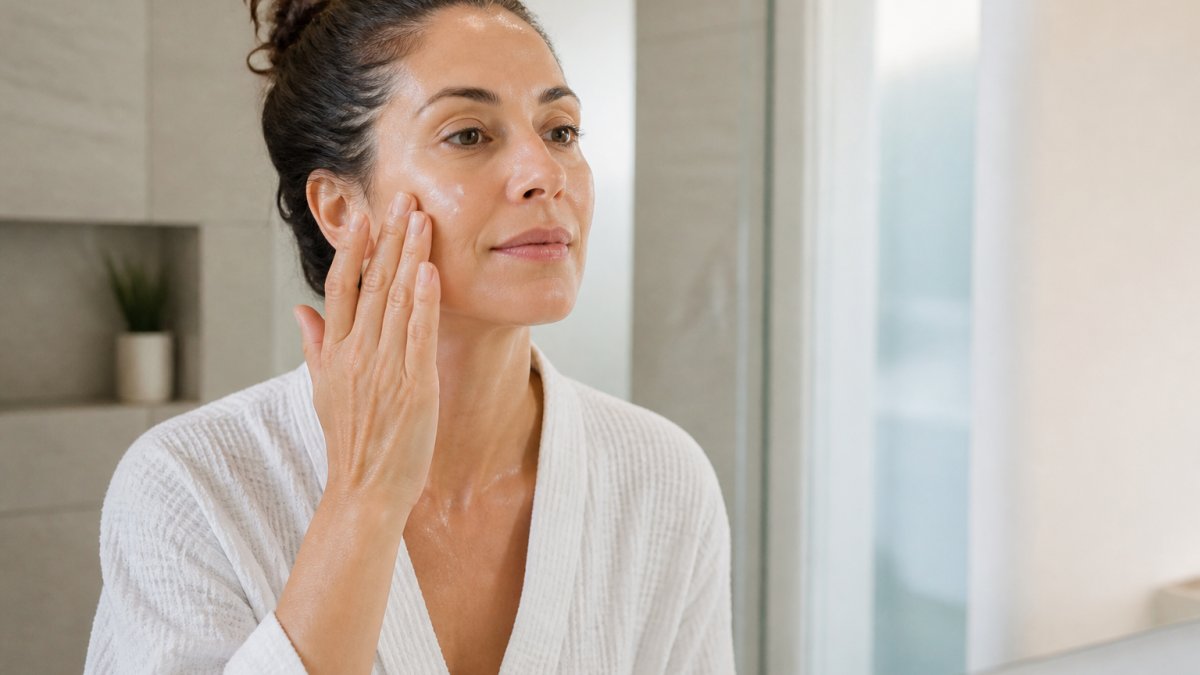
Follow this routine:
- Cleanse gently with lukewarm water. Hot water strips lipids.
- Pat, do not rub, and leave skin slightly damp.
- Apply the thinnest product first, usually a serum.
- Wait 30 to 60 seconds between layers.
- Press, do not scrub, the cream into the skin.
- Finish with the richest product to lock in moisture.
- Give it ten minutes before judging the finish.
Humidity matters too. In dry indoor air, a humidifier helps water-based formulas absorb instead of evaporating on the surface.
For the deeper layers, delivery technology does the heavy lifting. GALYNA's patented lipid delivery technology is designed to carry active ingredients past the surface, and the formula behind our DREAM Night Rejuvenating Crème carries US Patent #12,337,054. It pairs hemp extract with hyaluronic acid to hydrate and support collagen, and you apply it as the final step at night.

Skincare Pilling Causes and Fixes
Skincare pilling causes and fixes start with one question: is the residue a film or little rolled-up balls? Balls mean pilling. A smooth film usually means the product is simply occlusive.
Pilling happens when layers do not bond. Common triggers:
- Silicone-based products under water-based ones
- Too much product in one layer
- Rubbing instead of pressing
- Thick gels applied over powders or makeup
The fix is sequence and patience. Let each layer dry fully. Use less. Press products in with flat hands.
This is also how you tell normal residue from a real mismatch. A slight sheen that fades is normal. Balls of product rolling off mean the formulas are fighting each other.
When Residue Signals Irritation or a Damaged Barrier
Sometimes residue is not a texture problem. If a product that used to sink in now sits on top and stings, your barrier may be compromised.
Watch for these signs:
- Stinging or burning within seconds of application
- Redness that appears and does not fade
- Flaking in patches that were smooth before
- Products that suddenly pill when they never did
A damaged barrier loses its ability to regulate what enters. Ingredients that once felt fine now penetrate too fast and irritate. The answer is to simplify: gentle cleanser, one bland moisturizer, and time.
If irritation persists or worsens, see a dermatologist. Barrier damage can mimic other conditions, and a professional can tell the difference.
For sensitive or reactive skin, look for formulas built to support the barrier rather than strip it. That is the design brief behind our DREAM crème, which is made for all skin types, including the most sensitive. Customers rate GALYNA 5.0/5 based on 40 reviews.
Frequently Asked Questions
How long should skincare sit on your face before applying makeup?
Wait 2-3 minutes after applying skincare before makeup. This allows serums and moisturizers to absorb and form a smooth base. If you apply makeup immediately, products may pill or feel tacky. For products with occlusive ingredients like those in GALYNA's DREAM Night Rejuvenating Crème, wait until fully absorbed, especially at night.
Why does my skin not absorb products?
Several factors can prevent absorption: a compromised skin barrier, product buildup from not cleansing thoroughly, applying products in the wrong order, or using too much product. Additionally, molecule size matters, large molecules like hyaluronic acid sit on the surface. To improve absorption, apply to damp skin and layer from thinnest to thickest consistency.
Should you rub in moisturizer or let it sit?
Gently massage moisturizer into your skin using upward motions. Rubbing vigorously can cause irritation, while letting it sit may leave a greasy film. For best results, apply to damp skin and massage until absorbed. GALYNA's DREAM Night Rejuvenating Crème instructions recommend gently massaging a small amount onto face and neck until fully absorbed.
Can applying too much skincare make it feel like it sits on the skin?
Yes, using excessive amounts of product overwhelms the skin's ability to absorb, leaving residue. A pea-sized amount of serum and a nickel-sized amount of moisturizer are generally sufficient. If products consistently sit on your skin, try reducing the quantity and applying to damp skin to enhance absorption.
Most people treat a product that sits on the skin as a failed purchase. Usually it is a signal about application, layering, or barrier health, and all three are fixable. Start with damp skin, thin layers, and patience between steps. When you want a formula engineered to actually deliver, GALYNA's lipid delivery technology, pharmaceutical-grade standards, and clinically validated approach give your routine a real foundation. Try our starter pack today and give your skin something it can take in.

