
Table of Contents
- Why Your Skin Changes in Your 50s
- Step 1: Start with Gentle Cleansing and a Hydrating Cleanser
- Step 2: Add a Hydrating Toner and Moisture-Boosting Serum
- Morning Skincare Routine for Mature Skin
- Night Skincare Routine for Mature Skin with Retinol
- Best Retinol for Mature Skin: How to Introduce It Safely
- Skincare Routine for Sensitive Skin Over 50
- Realistic Timelines: When You'll Actually See Results
- Frequently Asked Questions
Last Updated: October 20, 2026
Your skin in your 50s isn't the same as it was at 30. The cellular turnover slows, collagen production drops, and the skin barrier becomes more fragile. That's why a best anti aging routine for 50s needs to shift from prevention to active repair. This guide from GALYNA breaks down the seven-step approach that addresses the specific changes mature skin faces, with practical strategies for introducing active ingredients safely and realistic timelines for seeing results.
Why Your Skin Changes in Your 50s
The biological reality is straightforward: your skin is aging faster than it did a decade ago. Collagen production declines roughly 1% per year after age 30, accelerating further after 50. Estrogen levels drop during and after menopause, which directly affects skin hydration and elasticity. The skin barrier weakens, meaning moisture escapes more easily and irritants penetrate more readily. Fine lines deepen into wrinkles. Texture becomes uneven. Skin tone loses radiance.
These aren't cosmetic concerns, they're structural changes. Your anti-aging routine for 50s must address them with intention. Generic skincare won't cut it. You need targeted active ingredients, consistent hydration, and sun protection that prevents further damage.
Step 1: Start with Gentle Cleansing and a Hydrating Cleanser
The foundation of any anti-aging routine 50s is a cleanser that removes dirt and makeup without stripping the skin barrier. Harsh cleansers damage mature skin further, leaving it tight and reactive. You need a hydrating cleanser, one that cleans effectively while preserving the lipids your skin desperately needs to retain moisture.
Look for cleansers with a creamy or oil-based texture. Avoid anything labeled "deep-cleaning," "purifying," or "clarifying", those are designed to strip, which accelerates visible aging. Glycerin, hyaluronic acid, and ceramides in your cleanser signal that it's formulated to hydrate while it cleanses. Massage the cleanser gently into damp skin for 30 to 60 seconds, then rinse with lukewarm water. Pat dry without rubbing.
This step matters more than most people realize. A compromised skin barrier makes every other product in your routine less effective. Start here, and the rest of your skincare routine for mature skin will perform better.
Step 2: Add a Hydrating Toner and Moisture-Boosting Serum
After cleansing, apply a hydrating toner. This step feels optional if you've never used one, but it's essential for mature skin. A toner preps the skin to absorb the active ingredients that follow. It adds an extra layer of hydration before serums and moisturizers go on. Look for toners with hyaluronic acid, glycerin, or niacinamide, ingredients that draw moisture into the skin and support barrier function.
Next comes a moisture-boosting serum. This is where you introduce lightweight hydration before your heavier creams. A good serum penetrates quickly and delivers humectants (ingredients that bind water to skin) deep into the epidermis. Many serums also contain antioxidants like vitamin C or niacinamide, which brighten and protect against environmental damage.
Apply the toner with your fingertips or a cotton pad, pressing gently into the skin. Follow with 2 to 3 drops of serum, warming it between your palms before patting it onto your face and neck. Wait 30 seconds for it to absorb before moving to the next step. This layering approach, toner, then serum, then moisturizer, ensures your skin receives maximum hydration.
| Step | Product Type | Key Ingredients | Wait Time |
|---|---|---|---|
| 1 | Hydrating Cleanser | Glycerin, hyaluronic acid, ceramides | 0 minutes |
| 2 | Hydrating Toner | Hyaluronic acid, glycerin, niacinamide | 30 seconds |
| 3 | Moisture-Boosting Serum | Hyaluronic acid, antioxidants, peptides | 30 seconds |
| 4 | Moisturizer | Ceramides, oils, humectants | 0 minutes |
Morning Skincare Routine for Mature Skin
Your morning routine should be simplified. You're protecting your skin from the day ahead, not treating it intensively. The priority is hydration and sun protection, nothing else matters as much.
Start with your gentle cleanser, even if you just woke up. Skin sheds cells and produces sebum overnight, so a quick rinse removes that buildup. Follow with your hydrating toner and serum, the same way you did the night before. Then apply a lightweight moisturizer.
The non-negotiable final step is broad-spectrum SPF 30 or higher. This is the single most effective anti-aging action you can take. UV damage causes 80% of visible skin aging, wrinkles, age spots, and loss of elasticity all accelerate with sun exposure.
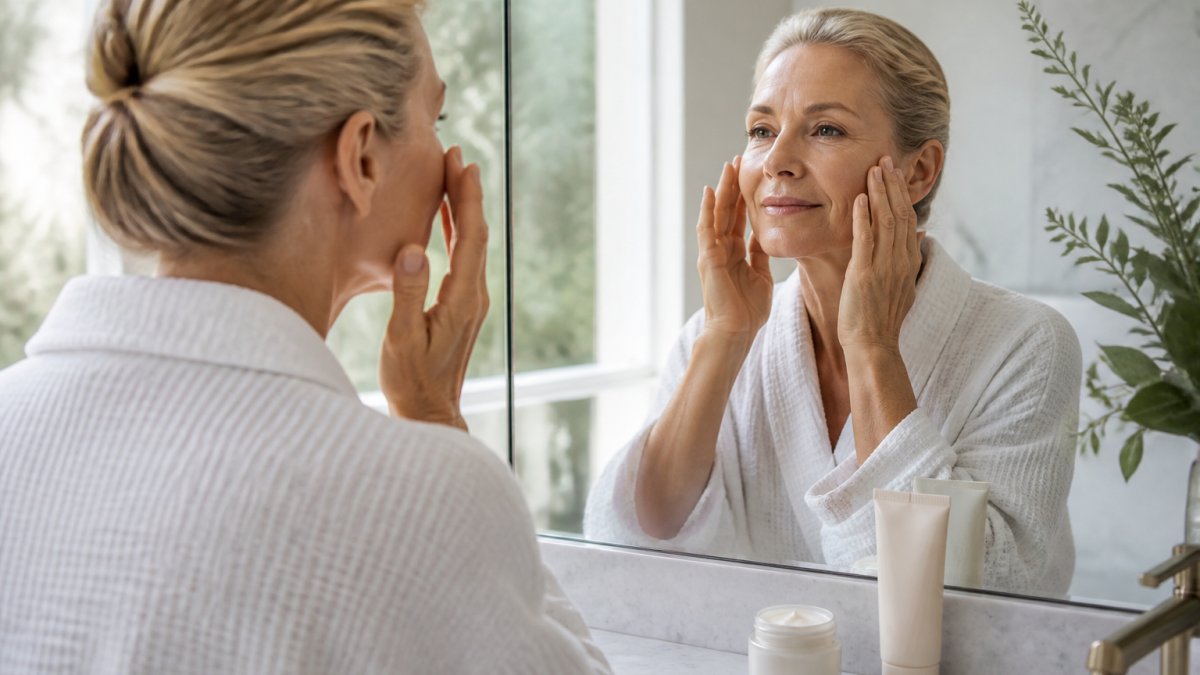
Many people skip sunscreen on cloudy days or assume their moisturizer's SPF is enough. It isn't. You need a dedicated sunscreen applied generously, about a quarter-teaspoon for your face. Reapply every two hours if you're outdoors, or after swimming or sweating. This consistency is what separates people who see anti-aging results from those who don't.
Night Skincare Routine for Mature Skin with Retinol
Your nighttime routine is where the real work happens. While you sleep, your skin's repair processes activate. This is when you introduce active ingredients like retinol, which accelerates cellular turnover and boosts collagen production. It's also when you apply heavier moisturizers that lock in hydration overnight.
Start with your cleanser, toner, and serum, the same as your morning routine. Then comes the retinol or retinoid step. This is the most powerful active ingredient for an anti-aging routine 50s. Retinol increases cell turnover, reduces fine lines, improves skin texture, and stimulates collagen. But it requires careful introduction, which we'll cover in the next section.
After your retinol has absorbed (usually 10 to 15 minutes), apply a richer night moisturizer. This is where GALYNA's DREAM Night Rejuvenating Crème becomes valuable. Formulated with Hemp Extract and hyaluronic acid, it boosts collagen production while you sleep and reduces fine lines and wrinkles. The lavender essential oil promotes relaxation. Apply it to your face and neck, massaging gently until absorbed.

Your nighttime routine takes longer than your morning one, but consistency here produces the visible results that make people ask what you're doing differently.
Best Retinol for Mature Skin: How to Introduce It Safely
Retinol is the gold standard for anti-aging, but many people introduce it wrong and experience irritation, redness, or flaking. The key is starting low and going slow. Your skin barrier in your 50s is already compromised, so aggressive retinol use will backfire.
Begin with a low-strength retinol (0.25% to 0.3%) used just twice weekly. Apply it on non-consecutive nights, Monday and Thursday, for example. Use only a pea-sized amount. Apply it to completely dry skin (wait 20 minutes after cleansing), and follow with your moisturizer. Never layer retinol under other actives like vitamin C or acids. Keep it simple: cleanser, toner, retinol, moisturizer.
After four weeks at twice weekly, you can increase to three times weekly if your skin tolerates it well. Redness, irritation, or peeling means you're moving too fast, drop back to twice weekly and stay there longer. After eight weeks, you can try increasing to four times weekly or moving to a slightly higher strength (0.5% to 0.75%).
DREAM Night Rejuvenating Crème (Classic Jar) →
What to expect: mild redness and slight flaking in the first two weeks. This is normal. If you experience severe irritation, burning, or persistent redness, stop and consult a dermatologist.
Skincare Routine for Sensitive Skin Over 50
If your skin is reactive, easily irritated, or prone to redness, your anti-aging routine 50s needs modification. The principles stay the same, but the execution becomes gentler. You're still addressing collagen loss and fine lines, you're just doing it without triggering inflammation.
Use the same four-step base: gentle cleanser, hydrating toner, moisture-boosting serum, and moisturizer. All of these should be fragrance-free and formulated for sensitive skin. Look for products labeled "hypoallergenic" or "dermatologist-tested." Avoid essential oils, alcohol, and common irritants like benzoyl peroxide or salicylic acid.
For active ingredients, introduce retinol even more gradually than the standard protocol. Start with just one application per week. Use the lowest available strength (0.25%). Wait six weeks before increasing frequency.
Consider alternatives to retinol if your skin remains reactive after eight weeks of once-weekly use. Bakuchiol is a plant-based alternative that provides retinol-like benefits without the irritation. It doesn't require the same slow introduction and works well for sensitive skin.
GALYNA's Essentials Mini Ritual offers an excellent starting point for sensitive skin. The SOOTHE Relief Cream is formulated with Vitamins A, C, and E. The REPAIR Healing Balm supports the appearance of smoother, healthier-looking skin.

Realistic Timelines: When You'll Actually See Results
The most common mistake is expecting immediate results. Skincare doesn't work like that, especially for mature skin.
Weeks 1-2: You'll likely experience some dryness or mild irritation if you're using new actives like retinol. Your skin may feel tighter or look slightly red. This is your barrier adjusting.
Weeks 3-4: Skin texture begins to improve. Fine lines may appear slightly less pronounced. Radiance starts returning. You'll notice your skin feels more hydrated if you're consistent with your routine.
Weeks 5-8: Visible improvements in fine lines and skin tone. Wrinkles look softer. Skin feels firmer. Spots or uneven pigmentation begin to fade if you're using vitamin C or retinol.
Weeks 9-12: Significant improvements in skin texture, firmness, and radiance. Fine lines are noticeably reduced. Wrinkles are less deep. Skin looks refreshed and healthier.
Months 4-6: Results continue to improve and stabilize. Collagen production increases, which means continued firmness improvements. Skin barrier function normalizes, meaning fewer sensitivity issues.
The catch: these timelines only work if you're consistent. Using your anti-aging routine 50s three times a week won't produce the same results as daily use. Skipping sunscreen undermines everything else you're doing.
Building the right anti-aging routine for your 50s addresses the specific changes your skin is experiencing.
Frequently Asked Questions
What is the best anti-aging routine for someone in their 50s?
An effective anti-aging routine for your 50s combines four core steps: gentle daily cleansing with a hydrating cleanser, consistent moisturizing to repair the skin barrier, retinol or retinoids introduced gradually to boost collagen production, and daily broad-spectrum SPF 30+ sunscreen. Layer these with serums containing vitamin C or niacinamide for brightening and antioxidant support. Consistency matters more than complexity, use the same routine for at least 8-12 weeks before expecting visible results in fine lines and skin texture.
How long does it take to see results from an anti-aging skincare routine?
Results depend on skin type, sensitivity, product potency, and how often you use active ingredients. Patience and adherence to your routine yield the best outcomes.
Should you use retinol in your 50s, and how often?
Yes, retinol and retinoids are highly effective in your 50s for reducing fine lines, boosting collagen, and improving skin texture. Start slowly with retinol 0.25-0.3% once or twice weekly, then gradually increase frequency to 3-4 times per week as your skin builds tolerance. Prescription retinoids (tretinoin, adapalene) work faster but require dermatologist guidance. Always apply retinol at night, use sunscreen daily the next morning, and avoid mixing with vitamin C or other actives until your skin adapts. Sensitive skin may need gentler introduction over 8-12 weeks.
What ingredients are most important for reducing wrinkles in your 50s?
Retinol and retinoids are the most proven for wrinkle reduction, they increase cell turnover and boost collagen. Hyaluronic acid provides deep hydration to plump fine lines. Vitamin C brightens and supports collagen synthesis. Niacinamide strengthens the skin barrier and reduces irritation. Peptides and antioxidants support skin firmness and protect against further damage. Hemp extract and other plant-derived actives reduce inflammation and support barrier repair. Sunscreen (SPF 30+) is essential to prevent new wrinkles. Combine these ingredients over weeks and months for visible results.
Can one product really handle anti-aging, sensitivity, and acne in your 50s?
A single product typically cannot address all three concerns equally well. However, a targeted routine using complementary products can. The GALYNA Essentials Mini Ritual combines SOOTHE, REPAIR, and DREAM (for anti-aging collagen and fine lines). This three-step approach addresses sensitivity while delivering anti-aging benefits. For persistent acne, add a gentle treatment with salicylic acid or niacinamide 1-2 times weekly. Most people see combined improvements within 6-8 weeks when they layer products strategically and use them consistently.

