Table of Contents
- How We Selected the Best Anti Aging Serums for Sensitive Skin
- Key Ingredients That Deliver Results Without Irritation
- Gentle Retinol Alternatives for Sensitive Skin
- How to Introduce Anti-Aging Serums to Sensitive Skin
- Signs of Skin Irritation From Anti-Aging Products
- Budget-Friendly vs. Luxury Anti Aging Serums: What Actually Matters
- Conclusion
- Frequently Asked Questions
Last Updated: September 17, 2026
How We Selected the Best Anti Aging Serums for Sensitive Skin
Most "gentle" formulas still trigger reactions because they pair strong actives with irritants. This GALYNA guide evaluates every option against ingredient safety, barrier support, and real-world tolerance.
We scored candidates on five factors:
- Active form and strength: Is the ingredient gentle enough for a compromised barrier?
- Supporting ingredients: Does the formula include ceramides, peptides, or soothing agents like cica?
- Irritant load: Fragrance-free, paraben-free, and free of synthetic dyes.
- Delivery method: Does the formula actually reach the dermal layer, or sit on the surface?
- Independent testing: Dermatologist-tested and hypoallergenic claims backed by data.
Ingredient Safety and Interaction Criteria
Ingredient interaction safety is the factor most buyers overlook. Niacinamide and vitamin C can be layered only at compatible concentrations and pH levels, while retinol and exfoliating acids in one routine often push sensitive skin past its tolerance threshold.
Selection Factor |
What We Checked |
Why It Matters |
|---|---|---|
Active form |
Encapsulated or buffered actives |
Slower release, less irritation |
Barrier support |
Ceramides, peptides, cica |
Repairs compromised skin |
Irritant load |
Fragrance-free, dye-free |
Prevents avoidable reactions |
Delivery |
Lipid or liposomal carriers |
Real absorption, not surface film |
Testing |
Dermatologist-tested |
Verifiable tolerance data |
Key Ingredients That Deliver Results Without Irritation
Antioxidants like vitamin C also earn a place, but choose a derivative such as sodium ascorbyl phosphate if pure L-ascorbic acid stings. It fights free radical damage and photoaging with far less irritation.
Peptides, Ceramides, and Niacinamide
These three ingredients form the backbone of a sensitive-skin routine. Peptides handle firmness and fine lines. Ceramides handle hydration and barrier repair. Niacinamide handles redness and tone.
Gentle Retinol Alternatives for Sensitive Skin
Gentle retinol alternatives for sensitive skin include bakuchiol, encapsulated retinol, retinaldehyde, and hydroxypinacolone retinoate (HPR). Each trades speed for tolerance; the right pick depends on how reactive your barrier is.
- Bakuchiol is a meroterpene from babchi plant seeds. It modulates retinol-responsive gene expression without binding the receptors that cause the classic retinol reaction, so most users skip the peeling phase. It is the slowest option, with results over 8 to 12 weeks.
- Encapsulated retinol wraps the retinol molecule in a lipid or polymer shell so it releases gradually. It is still real retinol and still converts to retinoic acid, but the hourly dose is lower, the closest you get to standard retinol results without the standard reaction.
- Retinaldehyde sits one conversion step from retinoic acid, versus two for retinol, so it works faster at the same concentration but leaves more irritating metabolite on skin. Sensitive users often tolerate 0.05% where 0.5% retinol would sting.
- Hydroxypinacolone retinoate (HPR) is a retinoate ester that binds retinoid receptors directly without converting to retinoic acid first. It is generally the best-tolerated "real" retinoid, though the least studied long-term.
How to Choose Between Them
Match the alternative to your barrier status, not to the marketing claim:
- Barrier currently reactive (redness, stinging, recent flare): start with bakuchiol. It is the only option on this list that does not require a tolerance-building phase.
- Barrier stable but retinol-naive: start with encapsulated retinol at 0.1% to 0.3%, twice weekly.
- Barrier stable and retinol-experienced but still reactive: retinaldehyde at 0.05% or HPR at 0.1% is the next step up.
- Barrier stable and you want maximum results: standard retinol at low concentration, buffered over a moisturizer, is still the most evidence-backed option.
The Buffering and Sandwiching Techniques
Buffering means mixing a pea-sized amount of retinoid with an equal amount of moisturizer before applying. This dilutes the dose and slows absorption, but a diluted active you can use nightly beats a full-strength one you use twice a month.
A Realistic Timeline
Sensitive skin typically needs 8 to 12 weeks to build tolerance to any retinoid, including gentle alternatives. Expect the first 2 to 3 weeks to be worst, with mild flaking and tightness that fades. If you are still reacting at week 6, the concentration or frequency may be too high, not the ingredient.
How to Introduce Anti-Aging Serums to Sensitive Skin
Introducing anti-aging serums to sensitive skin means starting slow: one product, low frequency, patch tested first. Rushing this step is the most common reason people abandon actives they could otherwise tolerate.
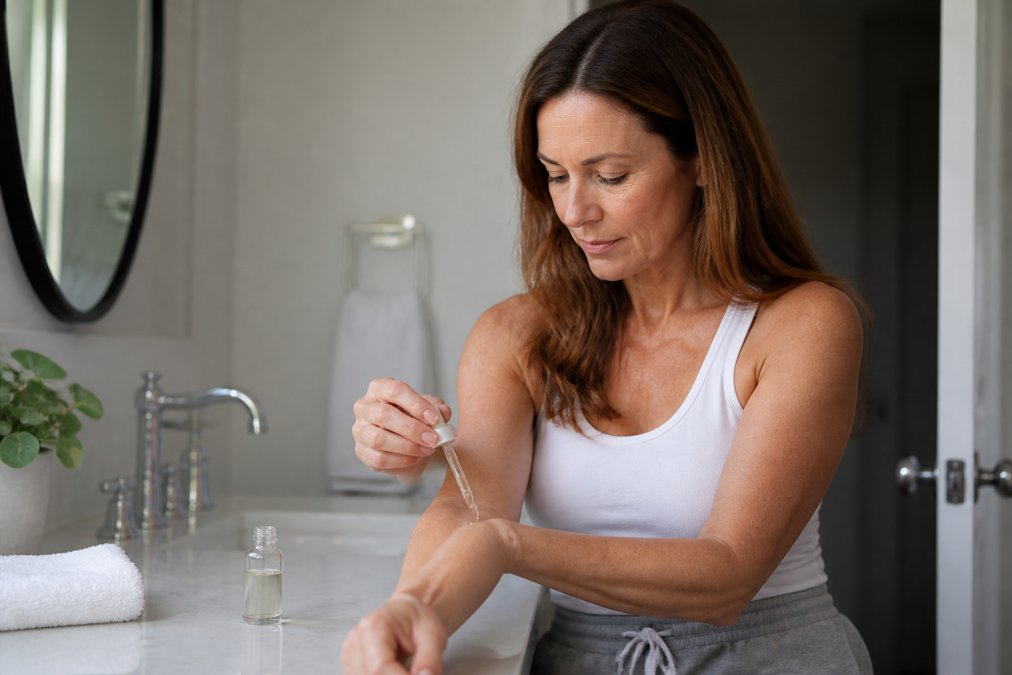
A practical four-week schedule works for most people:
- Week 1: Patch test on the inner forearm, wait 48 hours, watch for redness.
- Week 2: Apply to the face once every third night.
- Week 3: Move to every other night if there's no reaction.
- Week 4: Increase to nightly only if skin stays calm.
Patch Testing and Product Layering
Patch testing reveals a reaction before it hits your whole face. Apply a small amount behind the ear or on the inner forearm, then wait two full days. If redness, itching, or bumps appear, stop.
Signs of Skin Irritation From Anti-Aging Products
Signs of skin irritation from anti-aging products include persistent redness, stinging, flaking, and burning that lasts more than a few minutes. Mild tingling on application can be normal; ongoing inflammation is not.
Watch for these signals:
- Redness that lingers hours after application
- Dry, cracked patches that moisturizer can't fix
- New breakouts along the jaw or cheeks
- Itching or a warm, burning feeling
- Swelling or hives, which warrant stopping immediately
Irritation vs. Purging: How to Tell Them Apart
Purging happens when an active speeds up cell turnover and brings existing clogs to the surface faster. It shows up as small bumps in areas where you already break out (typically T-zone and chin), starts within 2 to 4 weeks, and resolves within 4 to 6 weeks with consistent use.
Ingredient Interactions That Cause Flare-Ups
Most irritation from anti-aging serums comes not from a single ingredient but from combinations that individually would be fine. The four worst offenders for sensitive skin:
- Retinoids plus exfoliating acids (AHA/BHA). Both accelerate turnover and temporarily compromise the barrier, compounding the effect past skin's tolerance threshold. Separate them by at least 24 hours.
- Vitamin C plus benzoyl peroxide. Benzoyl peroxide oxidizes L-ascorbic acid into a form that irritates rather than brightens. Do not layer them.
- Niacinamide plus high-concentration vitamin C. At compatible concentrations and pH these layer fine, but at high concentrations of both, niacinamide can convert to nicotinic acid, causing flushing and stinging. Keep niacinamide at 2% to 5% and vitamin C below 15%.
- Multiple actives in the same routine. Three actives in one routine is the most common cause of unexplained reactions. Two is the practical ceiling for sensitive skin.
Post-Procedure Skin: A Special Case
Skin that recently underwent a professional treatment (chemical peel, microneedling, laser, or dermabrasion) is in a different category. The barrier is temporarily compromised, and the rules change:
- Wait 7 to 14 days before reintroducing any active, depending on the depth of the procedure. Superficial peels need less time than medium-depth peels or microneedling.
- Skip retinoids and acids entirely during the recovery window. They will delay healing and increase the risk of post-inflammatory hyperpigmentation.
- Prioritize barrier repair with ceramides, peptides, and occlusives. This is the one period where a plain moisturizer outperforms any serum.
- Reintroduce actives one at a time, starting with the gentlest (peptides, then niacinamide, then a gentle retinoid alternative).
Budget-Friendly vs. Luxury Anti Aging Serums: What Actually Matters
Price does not predict results. What matters is the active form, its concentration, and the delivery system. A budget serum with encapsulated retinol and ceramides can outperform a luxury one built on fragrance and filler.
Judge a serum by its delivery technology and testing data, not its price tag. Absorption rate decides whether an active works at all.
Conclusion
Sensitive skin doesn't have to mean giving up on anti-aging results. The right serum pairs gentle actives with real barrier support and a delivery system that reaches the dermal layer.
Frequently Asked Questions
What is the best anti-aging serum for sensitive skin?
The best anti aging serums for sensitive skin use peptides, ceramides, and niacinamide instead of harsh retinoids or high-dose acids. Look for fragrance-free, non-comedogenic, pH-balanced formulas that support the skin barrier. GALYNA's patented lipid delivery technology uses CBD-infused, pharmaceutical-grade ingredients to penetrate the dermal layer without triggering redness or inflammation, making it a strong option for reactive skin types.
Which ingredients should sensitive skin avoid in anti-aging products?
Avoid synthetic dyes, parabens, added fragrance, and high concentrations of retinol or glycolic acid. These can strip the skin barrier and cause redness, stinging, and flaking. Also skip products with denatured alcohol, which speeds absorption but dries out sensitive skin. Instead, choose formulas with soothing agents like cica, hyaluronic acid, and ceramides. Always check for non-comedogenic and hypoallergenic labels before buying.
Can you use retinol if you have sensitive skin?
Some people with sensitive skin can use low-dose, encapsulated retinol, but many react with redness and peeling. Gentle retinol alternatives for sensitive skin include bakuchiol, peptides, and CBD. These support collagen production and cell turnover without the irritation. If you want to try retinol, start once a week with a pea-sized amount and buffer it with a ceramide moisturizer. Stop if you see persistent flaking or inflammation.
How long before you see results from anti-aging serums?
Serums typically need 8 to 12 weeks of consistent use before fine lines and elasticity visibly improve. Hydration and barrier repair often happen faster, within 2 to 3 weeks. Collagen production may increase after 4 to 6 weeks of daily use. Take photos every two weeks in the same lighting to track firmness and texture changes objectively.


