Table of Contents
- What Clinically Validated Really Means for Mature Skin
- Key Ingredients for Aging Skin That Have Real Evidence
- How to Build a Dermatologist Recommended Anti-Aging Routine
- Best Anti-Aging Serums for Sensitive Skin: What to Look For
- GALYNA DREAM Night Rejuvenating Crème: A Closer Look
- Comparing GALYNA Options for Clinically Validated Skincare
- Common Mistakes When Choosing Clinically Validated Skincare
- Frequently Asked Questions
Last Updated: September 25, 2026
What Clinically Validated Really Means for Mature Skin
Clinically validated skincare for mature skin means claims were tested on human volunteers under controlled conditions, measured by instruments or trained graders rather than marketing copy, backed by a published protocol, a defined duration, and a named lab.
Why Mature Skin Is Not Just "Older Skin"
Mature skin after 40 presents a specific problem: the epidermal barrier thins, cellular turnover slows, and collagen production drops. An active ingredient that sits on the surface does nothing for any of those. According to the American Academy of Dermatology's guidance on aging skin, barrier function and sun damage drive most visible aging, which is why penetration and protection matter more than the length of an ingredient list.
- Collagen drops faster. Estrogen supports fibroblast activity, so its decline accelerates the loss of collagen and elastin, the structural proteins behind firmness.
- Oil and moisture fall. Sebum production and the skin's ability to hold water both decline, which is why dryness that never bothered you at 35 becomes constant at 50.
- The barrier weakens. Thinner skin with fewer lipids loses water more easily and reacts more to irritants it once tolerated.
- Healing slows. Turnover and repair both decelerate, so a blemish or a scratch lingers longer.
What This Means for Validation
For skin navigating the hormonal shift, the most useful actives reinforce the barrier and hold moisture, ceramides, peptides, hyaluronic acid, and niacinamide, paired with a slowly introduced retinoid. Delivery technology determines whether they reach the layer where thinning happens.
Key Ingredients for Aging Skin That Have Real Evidence
Ingredients for aging skin fall into a few categories with genuine research behind them: retinoids, antioxidants like vitamin C, humectants like hyaluronic acid, barrier lipids like ceramides, and niacinamide. Each addresses a different part of the aging process.
- Retinoids: support cellular turnover and soften fine lines over time
- Vitamin C and other antioxidants: defend against photodamage and brighten uneven tone
- Hyaluronic acid: draws water into the skin for moisture retention
- Ceramides and peptides: reinforce the epidermal barrier and support collagen production
- Niacinamide: supports skin texture and helps calm redness
How to Build a Dermatologist Recommended Anti-Aging Routine
A dermatologist recommended anti-aging routine is built on four jobs: protect in the morning, repair at night, support the barrier daily, and stay consistent for at least twelve weeks. Skip any one and results stall. But the part most routines get wrong is not which products you use, it is the order and combinations.
The Order That Actually Matters
Apply products from thinnest to thickest: water-based serums, then emulsions, then creams, then occlusives, with sunscreen always last in the morning. Reverse that order and a rich cream forms a film that blocks the serum behind it, wasting your most expensive step.
What Not to Mix
Some actives genuinely conflict. A common pattern practitioners flag:
- Retinoids and strong acids (glycolic, salicylic, lactic) in the same sitting: both accelerate turnover, and together they overwhelm a thinning barrier. Alternate nights instead.
- Benzoyl peroxide and retinoids: benzoyl peroxide can degrade certain retinoids, reducing what actually reaches the skin. Use one in the morning and one at night, or alternate.
- Vitamin C and niacinamide: the old claim that they cancel each other out is overstated in modern stable formulas, but layering high concentrations of both at once still raises irritation risk for reactive skin. Separate them, vitamin C in the morning, niacinamide at night.
- Multiple exfoliating acids at once: AHA plus BHA plus a retinoid in one week is the fastest route to a damaged barrier.
Morning: Protection and Antioxidant Support
Morning is about defense: gentle cleanser, antioxidant serum, moisturizer, then sunscreen with SPF 30 or higher. Sunscreen is not optional, it is the single most effective anti-aging step you can take.
Evening: Repair, Retinoids, and Barrier Recovery
Evening is about repair: cleanse, apply your retinoid if you use one, then a barrier-supporting moisturizer. Retinoids work overnight, when cellular turnover peaks and skin is not fighting UV.
| Time | Step | Purpose | Frequency |
|---|---|---|---|
| Morning | Cleanser | Remove overnight buildup | Daily |
| Morning | Antioxidant serum | Defend against photodamage | Daily |
| Morning | Moisturizer | Maintain moisture retention | Daily |
| Morning | Sunscreen SPF 30+ | Block UV and prevent photoaging | Daily |
| Evening | Cleanser | Remove sunscreen and debris | Daily |
| Evening | Retinoid | Support cellular turnover | 2-7x weekly |
| Evening | Night cream | Barrier repair and hydration | Daily |
The Twelve-Week Rule
Collagen and cellular turnover respond on a twelve-week timeline, not a twelve-day one. Take a baseline photo in consistent lighting, then compare at weeks four, eight, and twelve. Most people quit at week three, right before visible change would have shown up.
Best Anti-Aging Serums for Sensitive Skin: What to Look For
The best anti-aging serums for sensitive skin prioritize barrier support and low irritation risk over maximum active concentration. Look for fragrance-free, hypoallergenic formulas, and check whether the brand has run clinical irritation trials.
DREAM Night Rejuvenating Crème (Classic →
- Encapsulation: keeps actives stable and releases them gradually, reducing the spike that triggers irritation
- Non-comedogenic carriers: prevent clogged pores in skin that is both sensitive and acne-prone
- Clinical irritation testing: a claim of "non-irritating in clinical trials" is worth more than "gentle" on a label
GALYNA DREAM Night Rejuvenating Crème: A Closer Look
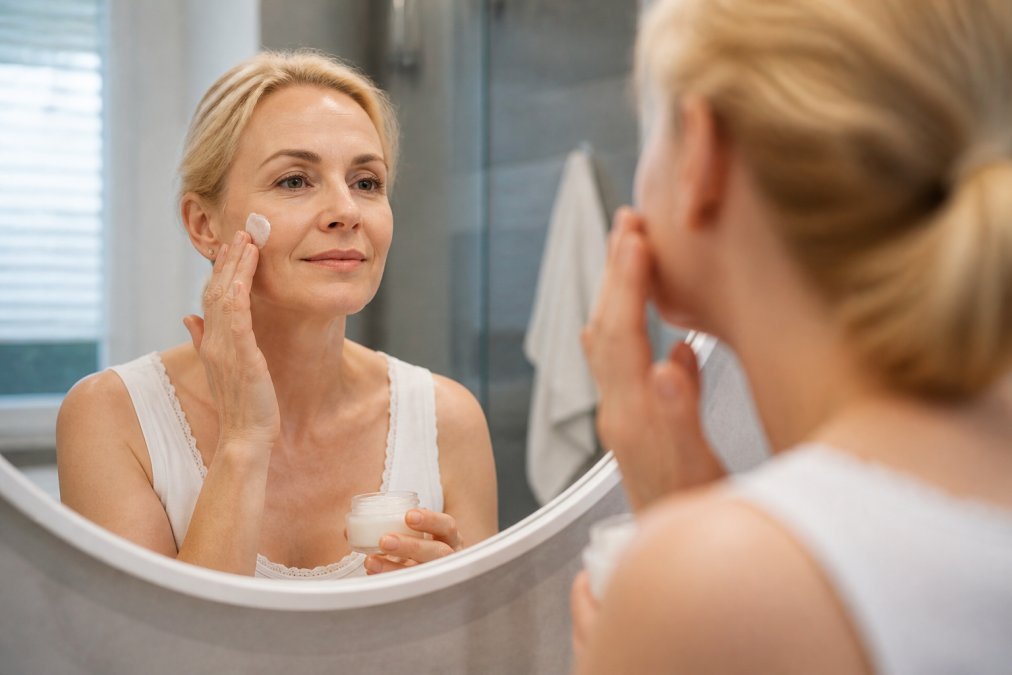
GALYNA DREAM Night Rejuvenating Crème is a nightly moisturizer built on patented lipid delivery, designed to boost collagen production, reduce the look of fine lines, and replenish the lipids mature skin loses. It carries US Patent #12,337,054, which covers the encapsulation technology behind how the actives reach the skin.
Patented Lipid Delivery and Clinical Validation
Patented lipid delivery separates this crème from a standard night moisturizer. The encapsulation carries actives deeper into the skin, so more active reaches the layer where collagen production and barrier repair happen.
Who It Works Best For
This crème suits adults with compromised barriers: dryness, reactivity, loss of elasticity, and dullness. It is also formulated to combat acne-causing bacteria, fitting skin that is both mature and breakout-prone. If pregnant or nursing, consult your doctor before use.
Comparing GALYNA Options for Clinically Validated Skincare
GALYNA's range gives you three entry points depending on commitment level and whether you want to test before investing. The full-size jar is the standard pick. The mini is the low-risk trial. The Essentials Mini Ritual is the full three-step system.

| Product | Size | Price | Best For |
|---|---|---|---|
| DREAM Night Rejuvenating Crème (Classic Jar) | 1.7 fl oz | $51.00 | Established nightly routine |
| DREAM Night Rejuvenating Crème (Mini Jar) | 0.4 fl oz | $20.00 | First-time trial |
| GALYNA Essentials Mini Ritual | 3 x 0.4 fl oz | $50.00 | Full SOOTHE, REPAIR, DREAM routine |
| DREAM Night Rejuvenating Crème (Case of 6) | 6 x 1.7 fl oz | $184.00 | Household or professional use |
| DREAM Night Rejuvenating Crème (Case of 12 mini) | 12 x 0.4 fl oz | $144.00 | Gifting or sampling |
Common Mistakes When Choosing Clinically Validated Skincare
Four more traps catch mature skin buyers repeatedly:
- Chasing single ingredients: a "retinol serum" and a "vitamin C serum" layered carelessly can cancel each other out or overload reactive skin
- Ignoring the barrier: actives without ceramides or lipids leave the skin more compromised, not less
- Expecting overnight results: collagen and cellular turnover respond on a twelve-week timeline, not a twelve-day one
- Skipping sunscreen: no night cream undoes daily UV exposure, and photodamage is cumulative
"Clean" has no legal definition in skincare, so check whether a brand publishes its Certificate of Analysis and ingredient sourcing. GALYNA makes its COA available for DREAM, a concrete transparency signal rather than a label claim.
Frequently Asked Questions
What is the best medical-grade skincare for mature skin?
Medical-grade skincare for mature skin should combine clinically validated actives with delivery systems that penetrate beyond the surface. Look for formulas with hyaluronic acid, antioxidants, and collagen-supporting ingredients. GALYNA's DREAM Night Rejuvenating Crème uses patented lipid delivery technology to carry hemp extract and hyaluronic acid deeper into the skin, supporting collagen production and reducing fine lines. The formula is classified as non-irritating in clinical trials, making it suitable for sensitive mature skin.
How can I tell if a skincare product is clinically validated?
Clinically validated means the formula or its key ingredients have been tested in controlled studies with measurable outcomes. Check for a patent number, published trial data, or third-party lab validation. GALYNA holds US Patent #12,337,054 for its Dream Night Crème and cites 21 independent lab-validated claims. A COA (Certificate of Analysis) should also be available. If a brand cannot point to specific studies or patents, the clinical claim is likely marketing language.
What ingredients should I look for in a dermatologist recommended anti-aging routine?
A dermatologist recommended anti-aging routine typically includes retinoids for cellular turnover, vitamin C for antioxidant protection, hyaluronic acid for hydration, and ceramides or peptides for barrier support. Niacinamide helps with hyperpigmentation and redness. SPF 30+ every morning is non-negotiable for preventing further photodamage. For sensitive skin, fragrance-free and hypoallergenic formulas reduce irritation risk. GALYNA's Essentials Mini Ritual combines three targeted formulas (SOOTHE, REPAIR, and DREAM) that cover soothing, barrier repair, and overnight rejuvenation in one set.
Are the best anti-aging serums for sensitive skin different from regular ones?
Yes. The best anti-aging serums for sensitive skin avoid high concentrations of irritants like retinol or fragrance and instead use encapsulated or buffered actives. They prioritize barrier repair ingredients such as ceramides, niacinamide, and hyaluronic acid. Non-comedogenic and hypoallergenic formulas reduce the risk of breakouts and redness. GALYNA's DREAM Night Rejuvenating Crème is formulated with clean ingredients and no artificial fragrances, and it has been classified as non-irritating in clinical trials, which matters for reactive skin.
How long before I see results from clinically validated skincare for mature skin?
Most clinical studies on anti-aging ingredients measure results over 8 to 12 weeks. Hydration and skin texture improvements may appear within 2 to 4 weeks, while fine lines, elasticity, and hyperpigmentation changes typically take longer. Consistency matters more than concentration. Using a product like GALYNA's DREAM Night Rejuvenating Crème nightly, as directed, supports your skin's natural overnight recovery. Customers rate GALYNA 5.0/5 based on 40 reviews, with many reporting visible improvement in firmness and hydration.


