
Table of Contents
- How CBD and Retinol Differ for Anti-Aging
- Retinol Side Effects and Skin Irritation: What to Expect
- CBD Skincare for Sensitive Skin: Why It Reduces Risk
- How to Layer Retinol and CBD Without Irritation
- Concentration Guidelines and Skin Type Compatibility
- Contraindications and Ingredient Conflicts to Know
- Long-Term vs. Short-Term Results: CBD vs Retinol
- Frequently Asked Questions
Last Updated: September 20, 2026
How CBD and Retinol Differ for Anti-Aging
The choice between CBD vs retinol for anti-aging comes down to two different mechanisms: retinol accelerates cellular turnover through vitamin A derivatives, while CBD calms inflammation and supports the skin barrier through cannabinoid receptor interaction. Most dermatologists recommend retinol for structural wrinkle correction and CBD for barrier repair and sensitivity management.
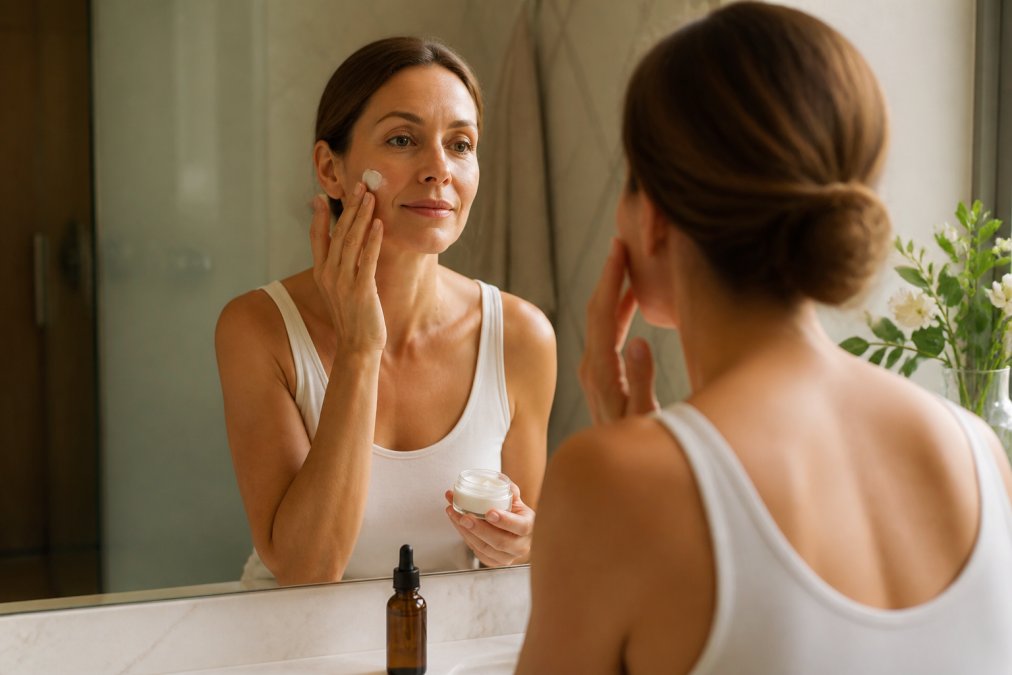
Retinol has decades of clinical backing. CBD skincare is newer, with growing research into its anti-inflammatory and antioxidant properties.
At GALYNA, we formulate with both concerns in mind. Our approach combines pharmaceutical-grade actives with patented lipid delivery technology to address what each ingredient does best.
The two ingredients are not competitors.
What Retinol Does for Fine Lines and Wrinkles
Retinol is a topical retinoid that speeds up cellular turnover and stimulates collagen synthesis in the dermal matrix. It works by binding to retinoic acid receptors in skin cells, which triggers faster desquamation and new cell production.
What CBD Does for Skin Barrier Function and Collagen
CBD, or cannabidiol, is a plant-derived compound that interacts with cannabinoid receptors in the skin. Unlike retinol, CBD does not accelerate turnover. Instead, it reduces oxidative stress and supports the lipid barrier.
Retinol Side Effects and Skin Irritation: What to Expect
Retinol side effects and skin irritation typically peak during weeks two through six of use. Common reactions include dryness, flaking, redness, and a stinging sensation when applying other products.
CBD Skincare for Sensitive Skin: Why It Reduces Risk
CBD skincare for sensitive skin works because CBD has anti-inflammatory properties that calm the reactivity retinol creates. When formulated with barrier-supporting ingredients, CBD reduces the risk of retinoid irritation without blocking retinol's mechanism.
How to Layer Retinol and CBD Without Irritation
The correct order for how to layer retinol and CBD is: cleanse, apply CBD serum first, wait, then apply retinol, and finish with a barrier cream. This sequence buffers retinol's penetration without reducing its effectiveness. The reason is mechanical, not marketing: a CBD-and-lipid layer raises the water content of the outer skin and slows the rate at which retinol reaches the living epidermis, which flattens the irritation spike without stopping the retinoic-acid receptor binding that drives results.
Here is the exact routine:
- Cleanse with a gentle, non-stripping cleanser and pat dry
- Apply CBD serum to damp skin and wait 2 minutes
- Apply a pea-sized amount of retinol to dry skin, avoiding the eyelids, nasolabial folds, and corners of the mouth
- Wait 5 minutes for absorption
- Seal with a ceramide or lipid-based night cream
Why Order Matters More Than Product Choice
Most irritation from combining these actives comes from sequence and timing, not from the ingredients themselves. Three patterns explain nearly every bad reaction:
- Retinol first, CBD second. Applying retinol to bare skin maximizes penetration and the sting that follows. The CBD then sits on top of an already-reactive barrier and does less buffering.
- Both at once. Mixing them in your palm before application gives you no control over the ratio, so you cannot dial retinol down on a bad week without also cutting your CBD dose.
- CBD oil instead of serum. Raw or carrier-oil CBD can create an occlusive film that traps retinol against the skin, which increases, rather than reduces, irritation.
Adjusting the Routine as Tolerance Builds
- Weeks 1-4: CBD serum first, retinol after, barrier cream to finish. Two nights per week.
- Weeks 5-12: Keep the same order but add a third retinol night if there is no stinging.
- Month 4 and beyond: On strong-tolerance nights, some users apply retinol first and CBD after to maximize turnover, then return to the buffered order if sensitivity returns.
If you are using a prescription retinoid such as tretinoin, treat the layering rules as a starting point and introduce CBD on separate nights first. Prescription retinoids are far stronger than over-the-counter retinol, and the buffering effect of a CBD serum is smaller against them.
Concentration Guidelines and Skin Type Compatibility
Most articles on this topic speak in generalities about "starting slow." This section gives you the actual numbers. Retinol concentration should start at 0.01% to 0.03% for beginners and sensitive skin types. Experienced users can move to 0.05% or 0.1%, but only after building tolerance over several months. Going from 0.03% to 0.1% in one step is the single most common reason people give up on retinol.
Skin Type |
Retinol Start |
CBD Range |
Frequency |
|---|---|---|---|
Sensitive |
0.01% |
2-5% |
2x per week |
Normal |
0.03% |
1-3% |
3x per week |
Oily/Acne-prone |
0.05% |
1-2% |
3-4x per week |
Mature |
0.05-0.1% |
3-5% |
4-5x per week |
Reading a Label Without Getting Fooled
Concentration on a label is only useful if you know what it refers to. Three things to check:
- Retinol vs. retinyl palmitate. Retinyl palmitate is a much weaker ester and is often listed at higher percentages to sound impressive. If the label says 1% retinyl palmitate, that is not the same as 1% retinol.
- Encapsulated vs. free retinol. Encapsulated retinol releases more slowly, so a 0.1% encapsulated product can feel gentler than a 0.05% free retinol. The percentage alone does not tell you the irritation profile.
- CBD isolate vs. full-spectrum. Full-spectrum hemp extract contains additional plant compounds that some users find more soothing, while isolate is a single purified molecule. Neither is universally better; the delivery system matters more than which one is listed.
Matching the Pair to Your Skin Type
- Sensitive skin: Start retinol at 0.01% twice weekly and keep CBD at the higher end of the range (2-5%) to buffer. Expect the first four weeks to include some dryness even at this dose.
- Normal skin: 0.03% retinol three nights a week with 1-3% CBD is a sustainable baseline for most people. Increase retinol only after four consecutive irritation-free weeks.
- Oily and acne-prone skin: 0.05% retinol three to four nights a week with 1-2% CBD. Lower CBD percentages are usually enough here because the goal is calming inflammation around active breakouts, not heavy barrier repair.
- Mature skin: 0.05-0.1% retinol four to five nights a week with 3-5% CBD. Mature skin often tolerates higher retinol doses but has a thinner barrier, so the CBD layer does more work.
Contraindications and Ingredient Conflicts to Know
Retinol should not be used during pregnancy or while nursing. If pregnant or nursing, consult your doctor before using any retinol product. This is a firm contraindication, not a precaution.
Long-Term vs. Short-Term Results: CBD vs Retinol
Short-term results from retinol appear in 4-8 weeks as smoother texture and reduced dullness. Long-term collagen remodeling takes 6-12 months of consistent use. This is when fine lines and wrinkles show measurable improvement.
Frequently Asked Questions
Can CBD and retinol be used together in a skincare routine?
Yes, they can be combined, but the order and timing matter. Retinol increases cellular turnover and can cause dryness and peeling, while CBD helps calm inflammation and support the skin barrier. A common approach is to apply a low-concentration retinol first, wait a few minutes, then follow with a CBD-infused moisturizer. Start with retinol two or three nights per week and build tolerance before adding more frequency.
Is CBD a suitable alternative to retinol for sensitive skin?
For people who cannot tolerate retinol's side effects, CBD skincare for sensitive skin is a reasonable substitute, though it works differently. CBD does not accelerate cellular turnover the way retinol does. Instead, it targets oxidative stress, supports the lipid barrier, and reduces visible redness. If your main concerns are fine lines and wrinkles rather than sensitivity, retinol remains the more studied option for collagen synthesis.
How long before I see results from CBD vs retinol for anti-aging?
Retinol typically shows measurable changes in skin texture and fine lines after 12 to 24 weeks of consistent use, because it works by altering how skin cells turn over. CBD's effects on redness, hydration, and barrier comfort can appear within two to four weeks. Long-term collagen benefits from either ingredient require months of nightly use. Expect gradual improvement rather than overnight change.
What concentration of retinol should a beginner start with?
Dermatologists generally suggest starting with a low concentration of retinol for new users, especially those with sensitive or reactive skin. Higher concentrations are often more effective for photoaging but carry a greater risk of erythema, peeling, and barrier disruption. Begin with the lowest strength twice weekly and increase only after your skin adjusts without irritation.
Are there ingredients I should avoid mixing with retinol?
Avoid combining retinol in the same application with strong exfoliating acids such as glycolic or salicylic acid, benzoyl peroxide, and high-concentration vitamin C. These can amplify irritation and compromise the skin barrier. CBD, hyaluronic acid, niacinamide, and ceramides are compatible and can help offset retinol side effects and skin irritation when layered in the same routine.
The challenge with CBD vs retinol for anti-aging is not choosing one. It is building a routine where both work without triggering irritation. GALYNA's DREAM Night Rejuvenating Crème supports that balance with patented lipid delivery technology, pharmaceutical-grade hemp extract, and a formula designed for sensitive and compromised skin. Customers rate it 5.0/5 based on 40 reviews. Get started with GALYNA and wake up to a stronger, more resilient complexion.


