
Table of Contents
- Why CBD Skincare for Sensitive Skin Needs a Cautious Approach
- How to Patch Test CBD Skincare Before You Commit
- CBD Skincare Ingredients to Avoid if Your Skin Reacts Easily
- CBD Skincare Side Effects: What to Expect and What's a Red Flag
- Building a CBD Skincare Routine for Sensitive Skin
- How to Read a CBD Skincare Label Before You Buy
- When CBD Skincare Isn't Enough: Signs You Need a Dermatologist
- Conclusion
- Frequently Asked Questions
Last Updated: October 5, 2026
Why CBD Skincare for Sensitive Skin Needs a Cautious Approach
CBD skincare for sensitive skin works best when you introduce one product at a time and give your barrier time to adjust.
At GALYNA, we build every formula around that reality. Our patented lipid delivery technology ensures that active, CBD-infused ingredients penetrate deep into the skin to repair damage, boost collagen production, and strengthen the skin barrier.
Reactive skin has a thinner margin for error. The American Academy of Dermatology's guidance on sensitive skin makes the same point: irritant reactions build with repeated exposure, not just first contact.
That is why the routine below moves slowly. Patch test first, add one product at a time, and stop the moment your skin pushes back.
How to Patch Test CBD Skincare Before You Commit
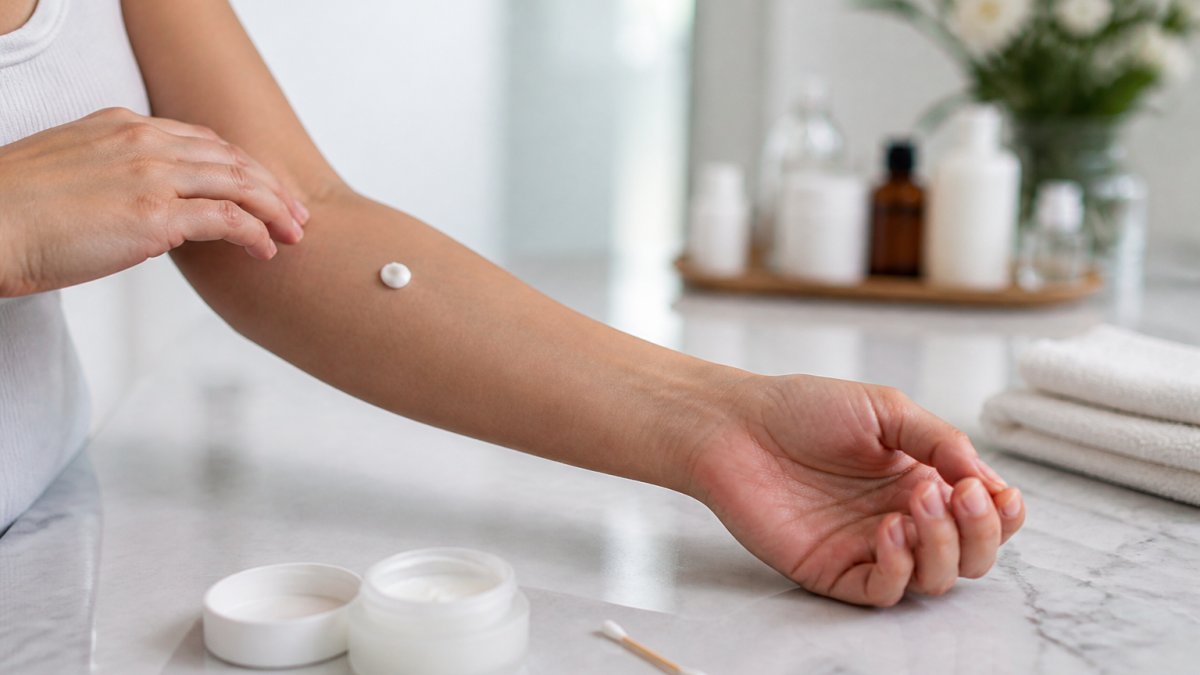
A proper patch test takes 48 to 72 hours on a small area of skin before you apply a new CBD product to your face, the cheapest way to avoid a full-face reaction.
Where to Patch Test and How Long to Wait
Apply a small amount behind your ear or on the inner forearm. Use the same amount you would use on your face, and leave it uncovered.
Check the spot at 24, 48, and 72 hours. Most irritant reactions appear within 48 hours, but delayed reactions happen, which is why the full 72-hour window matters for hypersensitive skin.
What a Reaction Looks Like and What to Do Next
Mild tingling that fades within minutes is common with active formulas. Persistent redness, swelling, itching, or a rash is not.
If you see those signs, wash the area with cool water and a gentle cleanser, then stop using the product. Do not "push through" a reaction, a compromised barrier will not build tolerance to an irritant.
CBD Skincare Ingredients to Avoid if Your Skin Reacts Easily
The CBD is rarely the problem. The supporting ingredient list usually is.
Fragrance, essential oils, drying alcohols, and harsh exfoliating acids are the most common triggers for reactive skin. So are preservatives like methylisothiazolinone, which the FDA's cosmetics ingredient resources flags as a known contact allergen.
Hemp seed oil is another one to watch: it is not the same as CBD and can irritate skin that does not tolerate seed oils well.
"Natural" and "gentle" are not the same claim, lavender oil is natural and also one of the more common sensitizers in skincare.
CBD Skincare Side Effects: What to Expect and What's a Red Flag
Most people tolerate topical CBD well, but "well tolerated" is not "risk-free," and reactive skin needs a clearer picture than a one-line reassurance.
The side effects that actually show up are usually mild, local, and short-lived:
- Dryness or tightness in the first few days, especially if the formula contains alcohol, witch hazel, or a strong surfactant.
- Slight redness or warmth right after application, which typically fades within 15 to 30 minutes.
- Temporary tingling or stinging, most often from essential oils, menthol, or preservatives rather than from CBD itself.
CBD is generally considered a low-irritation topical ingredient, but the vehicle it rides in usually decides whether your skin cooperates. A 2023 review of topical cannabidiol in dermatology found adverse events were mostly mild and local, though study sizes were small and follow-up periods short, an honest limitation, not a marketing point.
What a Real Red Flag Looks Like
Stop using the product and contact a dermatologist if you notice any of the following:
- Swelling of the face, lips, eyelids, or tongue
- Hives, welts, or a rash that spreads beyond the application area
- Blistering, oozing, or crusting
These signs point to contact allergy or a systemic reaction, not a normal adjustment period. "Pushing through" will not fix them, and continuing to apply the product can worsen sensitization.
What Topical CBD Is Not
This is where most guides get vague, so here is the plain version:
- CBD is not an eczema treatment. It may soothe and hydrate, but it does not replace prescription topicals, barrier repair, or trigger management.
- CBD is not an acne treatment. There is early, limited research on sebum regulation, but nothing that supports using CBD instead of proven actives like adapalene, benzoyl peroxide, or salicylic acid.
- CBD is not an antihistamine. It will not stop an allergic reaction, and it should never be used as a first response to one.
If your skin is inflamed, cracked, bleeding, or escalating, see a clinician before adding any new product, CBD or otherwise.
A Realistic Timeline
- Days 1-3: Possible mild tingling or dryness. Patch test should already be complete.
- Week 1: Skin should be settling, not getting worse. Any escalation is a stop signal.
- Weeks 2-4: Hydration and comfort are the realistic early wins. Visible redness reduction, if it happens, tends to show up here.
Set expectations around comfort and moisture, not clearing a condition. That framing keeps you honest about what the product can do and protects you from overspending on claims it cannot deliver.
Building a CBD Skincare Routine for Sensitive Skin
A sensitive-skin routine is short by design. Fewer steps mean fewer chances to trigger a reaction.
Morning: Protect and Calm
Cleanse with lukewarm water and a fragrance-free cleanser; hot water strips the barrier and worsens redness.
Follow with a light moisturizer while skin is still damp to lock in hydration and support the moisture barrier. Finish with sunscreen every morning, no exceptions.
Evening: Repair and Restore
Double cleanse only if you wore sunscreen or makeup. Otherwise, one gentle cleanse is enough.
REPAIR Healing Balm (Classic Jar) →
This is where a targeted CBD product earns its place. Our DREAM Night Rejuvenating Crème pairs hemp extract with hyaluronic acid for overnight recovery, plus lavender essential oil, and carries US Patent #12,337,054.

For dry patches and compromised areas, a balm beats a cream. Our REPAIR Healing Balm combines hemp extract with lanolin to protect damaged skin and support the barrier.


| Step | Product Type | When | Purpose |
|---|---|---|---|
| Cleanse | Fragrance-free cleanser | AM + PM | Remove buildup without stripping |
| Moisturize | CBD night crème | PM | Hydration and barrier support |
| Spot treat | CBD healing balm | As needed | Dry patches, damaged skin |
| Protect | Mineral sunscreen | AM | Prevent UV-driven redness |
How to Read a CBD Skincare Label Before You Buy
Most guides say "look for quality CBD" and stop there, useless at the shelf. Here is a 60-second label-reading framework built around the five things that matter most for reactive skin.
1. CBD Type: Isolate, Broad-Spectrum, or Full-Spectrum
- CBD isolate is cannabidiol alone, with other plant compounds removed. It is the most predictable option for sensitive skin because there is less to react to.
- Broad-spectrum contains CBD plus other cannabinoids and terpenes, but no THC. More plant material means more potential sensitizers.
- Full-spectrum includes trace THC (legally up to 0.3% in hemp-derived products). For most people this is fine topically, but it is the least "clean" option if your skin reacts to botanical complexity.
If your skin is genuinely reactive, isolate or broad-spectrum is the safer starting point; you can move up in complexity later.
2. Amount: Per Container vs. Per Dose
"500 mg CBD" on the front of a jar tells you nothing without the container size and how much you use per application.
Do the math:
- A 1.7 fl oz jar with 500 mg CBD contains roughly 500 mg across the whole jar.
- If you use about 0.5 mL per application, and the jar holds roughly 50 mL, you are getting about 10 mg of CBD per use.
That is the number that matters. A high total on the label can still mean a low dose per application if the container is large. Conversely, a small jar with a modest total can deliver more CBD per use.
3. The Rest of the Ingredient List
CBD is one line on a label that may have 30. Screen for these before you buy:
- Fragrance (listed as "fragrance" or "parfum"), the single most common cause of contact dermatitis in cosmetics.
- Essential oils, lavender, citrus, peppermint, eucalyptus, and tea tree are frequent sensitizers despite being "natural."
- Drying alcohols, denatured alcohol, SD alcohol, and isopropyl alcohol can strip an already-compromised barrier.
A short ingredient list built on familiar emollients (squalane, glycerin, ceramides, shea) and humectants is generally a better bet for sensitive skin than a long list of botanicals.
4. Third-Party Testing and COAs
A certificate of analysis (COA) is a lab report showing what independent testing actually found in a batch, cannabinoid content, and often contaminants like pesticides, heavy metals, and residual solvents.
What to check on a COA:
- Does the batch number match the product you are holding?
- Does the CBD amount match the label claim?
- Is there a date, and is it recent?
If a brand cannot or will not show you a COA, treat that as a decision, not a delay.
5. Claims vs. Evidence
Separate what is established from what is early:
- Established skincare practice: fragrance-free formulas, barrier-supporting emollients, sunscreen, and gradual introduction of new products.
- Early or limited evidence: topical CBD for redness, sebum control, or inflammation. Promising in small studies, not settled science.
- Not supported: claims that a CBD product treats eczema, acne, rosacea, or allergic reactions.
"Clinically validated" should mean you can find the specific claim and the testing behind it. If you cannot, treat the phrase as marketing.
When CBD Skincare Isn't Enough: Signs You Need a Dermatologist
CBD skincare is a support product, not a medical treatment. Knowing where that line sits protects your skin and your wallet.
See a dermatologist if you have skin that is cracked, oozing, or bleeding.
Persistent acne that leaves marks, or itching that disrupts your sleep, also warrants a professional opinion.
The National Eczema Association's resources for patients is a solid starting point if you are unsure whether your symptoms need clinical care.
Conclusion
Sensitive skin does not have to mean settling for a short ingredient list and no results. It means choosing formulas that respect your barrier and introducing them on your skin's timeline, not yours.
That is the standard we hold at GALYNA. Our CBD-infused formulas use patented lipid delivery technology to carry active ingredients into the skin, our DREAM Night Rejuvenating Crème is backed by US Patent #12,337,054, and every product is made with pharmaceutical-grade ingredients and clinically validated claims.
Start with the mini sizes, patch test properly, and give your skin two weeks before you judge the results. Try our starter pack today.
Frequently Asked Questions
Can CBD skincare irritate sensitive skin?
CBD itself is generally well tolerated, but irritation usually comes from other ingredients in the formula, such as added fragrance, essential oils, or preservatives. If you have reactive skin, patch test any new CBD skincare product on your inner forearm for 24 to 48 hours before applying it to your face. If you notice redness, itching, or burning, stop using it. Choosing fragrance-free formulas and products with short ingredient lists reduces your risk.
How do you patch test a CBD skincare product?
Apply a small amount to your inner forearm or behind your ear, two areas with thin, sensitive skin. Wait 24 to 48 hours and check for redness, itching, or swelling. If there's no reaction, test a small area on your jawline for another 24 hours before using it on your full face. Keep the product away from your eyes during testing, and never test more than one new product at a time so you can identify what caused a reaction.
What ingredients should you avoid in CBD skincare if you have sensitive skin?
Check the label for synthetic fragrance, alcohol denat, essential oils like citrus or peppermint, and harsh exfoliating acids. These are common triggers for reactive skin. Also watch for products that list CBD or hemp extract alongside a long ingredient list, since more ingredients means more chances of a reaction. Look for short formulas with recognizable moisturizers like hyaluronic acid or lanolin, and always patch test before committing.
How often should you use CBD skincare?
Start with once every other day, ideally in the evening, and increase to daily use only if your skin tolerates it well for one to two weeks. Sensitive skin benefits from a gradual introduction because it gives your barrier time to adjust. If you're using a richer product like a night cream or balm, once daily is usually enough. Pair it with a gentle cleanser and moisturizer, and avoid layering multiple new actives at the same time.

