
Table of Contents
- What CBD Is and How It Works in Skincare
- The Clinical Evidence Behind CBD Skincare for Wrinkles
- Does CBD Oil Work Topically on Skin
- CBD Skincare for Sensitive Skin: Safety and Efficacy
- CBD vs Retinol for Wrinkles: How They Compare
- How to Evaluate a CBD Skincare Product Label
- Building a Realistic CBD Skincare Routine for Anti-Aging
- Frequently Asked Questions
Last Updated: October 7, 2026
What CBD Is and How It Works in Skincare
Cannabidiol (CBD) is a compound extracted from hemp plants that, unlike THC, does not produce a high. In skincare, it is applied topically in creams, serums, and oils designed to interact with your skin's cannabinoid receptors.
Applied topically, CBD works on the skin's surface and outer layers. Your skin has its own endocannabinoid system, a receptor network that responds to cannabinoids, and CBD may help regulate oil production, inflammation, and cellular turnover.
The theory behind CBD for wrinkles centers on three mechanisms:
- Antioxidant protection, CBD may neutralize free radicals that contribute to oxidative stress and skin aging
- Anti-inflammatory action, CBD may reduce skin inflammation that accelerates wrinkle formation
- Barrier support, CBD may strengthen your skin barrier by supporting lipid retention and hydration
At GALYNA, we formulate CBD-infused products with pharmaceutical-grade hemp extract and our patented lipid delivery technology, so active ingredients penetrate deeply rather than sitting on the surface. Our DREAM Night Rejuvenating Crème pairs medicinal-grade hemp extract with hyaluronic acid and antioxidants to support collagen production and reduce the appearance of fine lines.

The key question remains: does this actually work for wrinkles? That depends on the clinical evidence.
The Clinical Evidence Behind CBD Skincare for Wrinkles
Does CBD skincare actually reduce wrinkles? The honest answer is: the evidence is limited and mixed.
Most CBD skincare claims rely on cellular and animal research rather than human trials focused on wrinkle reduction. These early-stage studies show antioxidant and anti-inflammatory properties in the lab, but lab results do not always translate to visible improvements in real people.
A few human studies on acne and dermatitis show promise for reducing inflammation and supporting barrier function, but very few rigorous trials have measured whether CBD reduces wrinkles or fine lines in humans over time.
Here's what the research actually supports:
- CBD has demonstrated antioxidant activity in cell cultures
- CBD may reduce inflammatory markers in skin tissue
- CBD shows potential for supporting skin barrier health
- Limited human data exists on wrinkle reduction specifically
The gap between "CBD has anti-inflammatory properties" and "CBD visibly reduces wrinkles" is significant: many ingredients show lab benefits without producing dramatic anti-aging results on human skin.
What matters is penetration depth, sustained presence in the skin, and clinical validation in humans over weeks or months. Here most CBD products fall short of retinol, which has decades of human clinical data supporting visible wrinkle reduction.
Does CBD Oil Work Topically on Skin
Topical application means applying a substance directly to the skin surface. To reduce wrinkles, CBD must penetrate beyond the outer dead skin cells to the deeper dermal layers where collagen lives.
Here most CBD products hit a fundamental problem: CBD is hydrophobic, so it does not dissolve easily in water, and standard oils and creams may not deliver it deep enough to affect collagen or elastin production.
The skin barrier blocks many molecules, especially large ones, so CBD needs a delivery system to cross it. Without one, CBD largely remains on the surface, providing minimal anti-wrinkle benefit.
GALYNA's patented lipid delivery technology addresses this with a lipid matrix that mimics your skin's natural oil barrier, helping CBD and other actives penetrate deeper rather than sitting on top.
When evaluating whether a CBD skincare product works topically, ask:
- Does the product specify a delivery system or penetration technology?
- Does the formula mention lipid delivery, encapsulation, or similar enhancement?
- Are there any clinical studies on THIS specific product's penetration depth?
- Does the brand provide evidence beyond general CBD antioxidant claims?
Most CBD products do not answer these questions clearly, relying on CBD's reputation without addressing the delivery challenge that determines whether it reaches the layers that matter for wrinkle reduction.
CBD Skincare for Sensitive Skin: Safety and Efficacy
CBD skincare for sensitive skin presents both opportunity and caution: its anti-inflammatory properties appeal to people with reactive or compromised barriers, but sensitive skin still requires careful ingredient selection and patch testing.
Is CBD safe for sensitive skin? Generally, yes, but with important caveats.
CBD itself has a low irritation profile in most people and rarely causes redness, burning, or allergic reactions.
People with sensitive skin should:
- Patch test any new product on a small area first (inner arm or behind ear)
- Wait 24-48 hours before applying to your face
- Start with the lowest recommended frequency (2-3 times per week)
- Monitor for redness, stinging, or increased dryness
- Stop use immediately if irritation develops
GALYNA formulates for sensitive and compromised skin. Our DREAM Night Rejuvenating Crème contains lavender essential oil, hyaluronic acid, and vitamins selected to support rather than stress a reactive barrier, repairing dry, reactive skin while you sleep, when natural recovery is most active.
For persistent acne, dullness, or a compromised barrier, CBD skincare may help: its anti-inflammatory action can reduce acne-related inflammation while antioxidants support healing. Still, CBD is one tool in a routine, not a complete solution for severe skin conditions.
CBD vs Retinol for Wrinkles: How They Compare
The comparison between CBD and retinol reveals why established anti-aging ingredients still dominate.
Retinol (vitamin A) has the strongest clinical evidence for reducing wrinkles. Decades of human studies show it increases cell turnover, stimulates collagen, and visibly reduces fine lines, with results measured and consistent across diverse skin types.
CBD, by contrast, has emerging science but limited human clinical data for wrinkle reduction. Its antioxidant and anti-inflammatory properties are real but do not yet equal retinol's proven anti-aging efficacy.
Here's how they differ:
| Factor | CBD | Retinol |
|---|---|---|
| Human clinical trials for wrinkles | Very limited | Extensive, decades of data |
| Mechanism for collagen | Indirect (via inflammation reduction) | Direct (stimulates fibroblasts) |
| Skin irritation risk | Low | Higher, especially at first |
| Best for sensitive skin | Better tolerated | Requires gradual introduction |
| Speed of visible results | Slower, if any | 6-12 weeks typical |
| Evidence quality | Cellular and animal studies | Human clinical studies |
This does not mean CBD is ineffective, only that retinol has stronger proof. For sensitive skin or retinol irritation, CBD may be a gentler alternative; for the fastest, most proven wrinkle reduction, retinol remains the better choice.
DREAM Night Rejuvenating Crème (Classic Jar) →
The ideal approach for many people is combining both: using retinol 3-4 nights per week and CBD-infused products on off-nights or as a daytime option. This strategy provides retinol's proven anti-aging power while using CBD's anti-inflammatory benefits to support skin barrier health and reduce irritation.
How to Evaluate a CBD Skincare Product Label
Not all CBD skincare products are equal. Many brands make broad anti-aging claims without evidence or quality ingredients, so learning to read a label protects you from overpaying for marketing hype.
What to look for on a CBD skincare label:
1. CBD source and concentration
- Does the label specify where the hemp is grown?
- Is the CBD concentration listed (e.g., "contains 500mg CBD per 1 oz")?
- Does the brand provide a Certificate of Analysis (COA) from a third-party lab?
Reputable brands disclose these details. Vague labels ("CBD-infused," "hemp-derived") without specific amounts are a red flag.
2. Delivery system or penetration technology
- Does the formula mention lipid delivery, encapsulation, or a proprietary delivery system?
- This indicates the brand has addressed the penetration challenge that affects topical CBD efficacy.
GALYNA's patented lipid delivery technology is a specific example: it is named, patented (US Patent #12,337,054), and designed to help active ingredients penetrate deeper than standard formulations.
3. Additional active ingredients
- What else is in the formula besides CBD?
- Does it contain proven anti-aging ingredients like retinol, peptides, or hyaluronic acid?
- Or is CBD the only active ingredient, relying entirely on CBD's unproven anti-wrinkle claims?
A strong formula combines CBD with complementary ingredients. GALYNA's DREAM Night Crème pairs hemp extract with hyaluronic acid for hydration, vitamins for nourishment, and lavender for relaxation.
4. Clinical validation
- Does the brand provide links to peer-reviewed studies on their specific product?
- Or do they reference only general CBD research that may not apply to their formula?
- Are there customer reviews or before-and-after results?
GALYNA has 21 independent lab-validated claims and maintains a 5.0/5 customer rating based on 40 reviews. This level of transparency is uncommon and valuable.
5. Regulatory compliance
- Is the product clearly labeled as a cosmetic or skincare product, not a drug?
- Does it avoid making disease claims (e.g., "treats wrinkles" vs. "reduces appearance of wrinkles")?
- Is there a clear ingredient list and safety information?
Brands making exaggerated medical claims risk regulatory action; trustworthy brands stay within cosmetic claim boundaries.
Building a Realistic CBD Skincare Routine for Anti-Aging
If you try CBD skincare, realistic expectations and consistency matter far more than jumping between products.
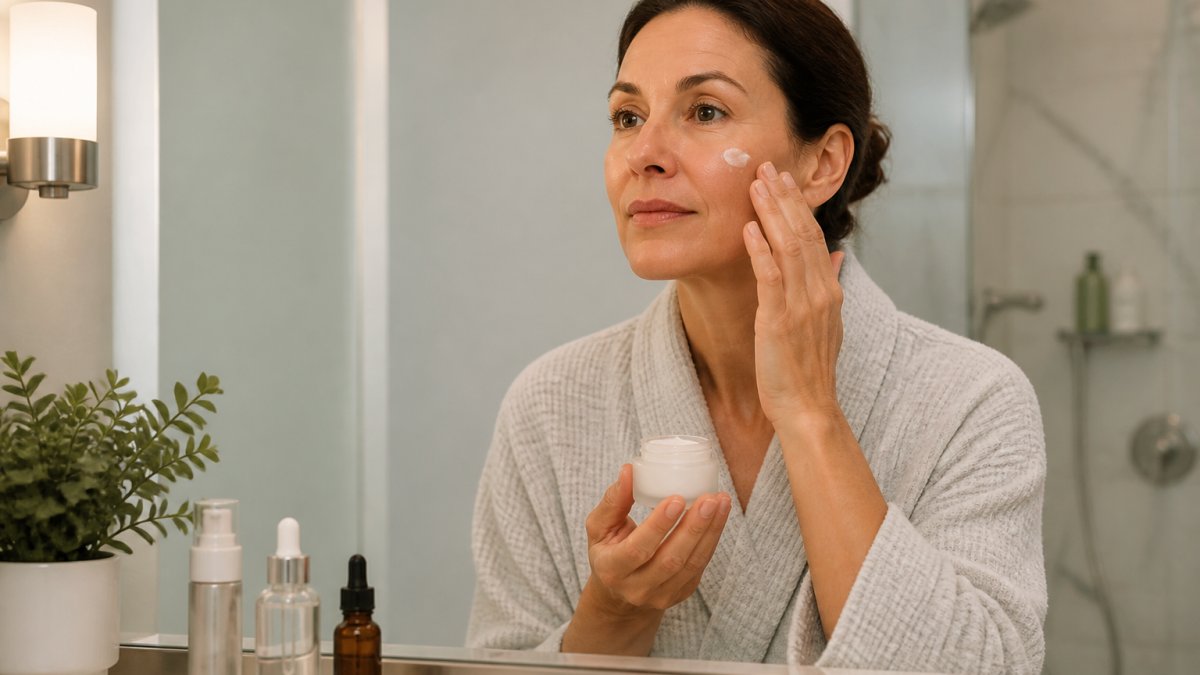
A realistic anti-aging routine with CBD:
Step 1: Cleanse (morning and night) Use a gentle cleanser suited to your skin type to remove oil, dirt, and dead skin cells that block active ingredients.
Step 2: Apply CBD skincare (night routine) After cleansing, apply a CBD-infused cream or serum to slightly damp skin, which absorbs products better than dry skin.
Step 4: Daytime protection In the morning, use a gentle moisturizer and always apply broad-spectrum SPF 30 or higher (the American Academy of Dermatology).
Timeline for results:
- Weeks 1-2: Skin feels more hydrated and calmer. No visible wrinkle changes yet.
- Weeks 3-6: Fine lines may appear slightly softer. Skin texture improves. Sensitivity may decrease if your barrier was compromised.
- Weeks 8-12: Gradual improvement in skin firmness and fine line appearance, especially if combined with retinol and sun protection.
- Months 4-6: More noticeable results if you maintain consistency. Significant wrinkle reduction typically requires this timeline or longer.
Consistency matters more than perfection.
Using your CBD product 4-5 nights per week for 12 weeks beats using it every night for 3 weeks then stopping.
The most common mistake is expecting overnight results.
If you have sensitive, reactive, or compromised skin, CBD skincare offers a gentler entry point to anti-aging care.
Try our starter pack today and experience how deep penetration and clinical validation can transform your skin health.
Frequently Asked Questions
Does CBD skincare actually reduce wrinkles, or is it just marketing hype?
CBD shows promise in early research for supporting skin health through anti-inflammatory and antioxidant effects, which may help reduce the appearance of fine lines over time. However, clinical evidence specifically for wrinkle reduction is limited compared to established ingredients like retinol. CBD may work best as part of a comprehensive anti-aging routine rather than as a standalone solution. Products like GALYNA's DREAM Night Rejuvenating Crème combine CBD with other proven ingredients like hyaluronic acid and antioxidants to address multiple signs of aging.
How does CBD oil work topically on skin, and does it actually penetrate deep enough to be effective?
CBD is lipophilic, meaning it dissolves in oils and fats, which allows it to penetrate the skin barrier when formulated correctly. Standard topical application alone has limited penetration depth. This is why delivery technology matters: GALYNA's patented lipid delivery system is designed to carry active CBD ingredients deeper into the skin where they can support collagen production and repair. The depth of penetration depends heavily on the formulation quality and how the product is engineered, not just the presence of CBD itself.
Is CBD skincare safe for sensitive skin, or can it cause irritation?
CBD itself is generally well-tolerated and has anti-inflammatory properties that may actually soothe reactive skin. However, sensitivity depends on the entire formula, not just the CBD. Some people react to other ingredients in CBD products. GALYNA formulates for sensitive skin with pharmaceutical-grade precision, using clean ingredients like lavender essential oil and hyaluronic acid. Always patch test first on a small area, especially if you have a history of reactions to skincare products, and consult a dermatologist if you have severe skin conditions.
Should I use CBD skincare or retinol for wrinkles?
Retinol has decades of clinical evidence for reducing fine lines and boosting collagen production, making it the gold standard for wrinkle treatment. CBD is newer and shows anti-inflammatory and antioxidant potential but lacks the same depth of wrinkle-specific research. Many dermatologists recommend starting with a proven retinol routine, then adding CBD products for their soothing and protective benefits, especially if you have sensitive skin that tolerates retinol poorly. Some people use both in different steps of their routine for complementary effects.


